When a product line starts moving, the conversation with your supplier changes. A few hundred decals per order becomes several thousand per week, and the question is no longer whether a transfer looks good in a sample photo. It is whether the same quality holds across a run of 50,000 pieces, delivered on a date you can put in a purchase order. That is the world of large-scale factory transfers, and it behaves very differently from buying small batches.
In this guide we cover how large-scale factory transfers run on our production floor, the capacity and quality numbers B2B buyers should ask for, and how to structure a high-volume program so your cash stays in inventory that actually sells.
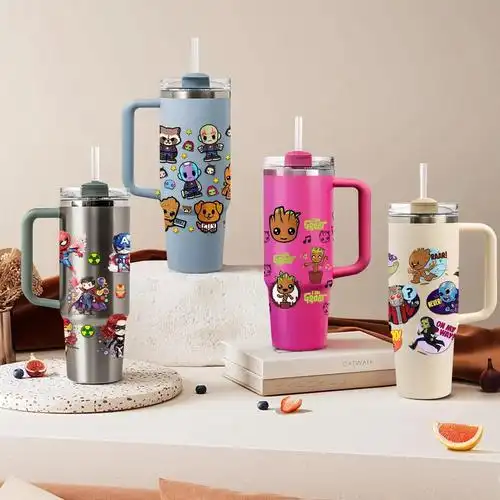
What Large-Scale Factory Transfers Mean in Practice
Large-scale factory transfers are UV DTF decals printed in volume on industrial equipment, in an environment where ink, film, lamination and cutting are controlled batch by batch, then packed and shipped to brands, resellers, distributors and print-on-demand businesses. The artwork does not change when you scale up. The process around it does
One industry term is worth defining. UV DTF (Direct to Film) is a digital printing method in which a UV-curable printer lays full-colour artwork onto a release film, adds a white layer for opacity, applies adhesive and a protective coating, and cures the ink with ultraviolet light. The transfer is applied by hand – position, press, peel – to glass, metal, wood, ceramic, plastic or coated board. With no heat press and no minimum material thickness, one format suits a tumbler, a laptop lid and a ceramic ornament alike.
For a wholesale buyer, the difference between a small batch and a factory-scale run is who controls the variables. At volume, consistency has to be designed in: recorded ink batches, fixed cure settings, verified cut paths, documented packing.
The Capacity Numbers That Decide Whether a Supplier Can Deliver
Capacity claims are cheap in this industry. “Large capacity” and “fast delivery” appear on almost every supplier page and tell you nothing you can plan against. For volume work, ask for figures that could be checked on an invoice:
- The number of UV DTF printers dedicated to transfer film, and how many run in parallel
- Daily and weekly output measured in square metres of film, not “sheets”
- Shifts per day, and whether the floor runs weekends
- Lead time for a repeat order versus a new artwork setup
- Peak-season policy: is capacity reserved for repeat accounts, or first come, first served?
As a reference point, a well-run UV DTF line typically produces several hundred square metres of film per day, and a factory with parallel lines can absorb a 20,000 to 50,000 piece program in a normal production month. What matters more than the headline figure is whether the factory commits three dates in writing: the start of your run, the quality checkpoint, and the ship date.
We reserve slots for repeat accounts first, because a buyer replenishing a proven design should not lose their window to a speculative enquiry. Planning a seasonal push? Give us the target date early and we schedule backwards from it, including customs clearance.
Why Quality Control Is a Volume Problem, Not a Sample Problem
Small batches hide defects. If two pieces in a hundred of a 300-piece run are off-register, you trim them and move on. At volume the same rate becomes money: 2% across 25,000 pieces is 500 unusable units, plus the labour of sorting them and the risk of a marketplace return. On large-scale factory transfers, quality control is a cost-control function.
The gates that keep a volume run clean are unglamorous and specific:
- Incoming material checks – film and ink batch codes recorded against your order
- First-article approval – a printed and applied sample signed off before the run continues
- Cure and adhesion spot checks – every shift, on the surface your customers will actually use
- Cut-path verification – contour accuracy checked so decals release cleanly
- Outgoing AQL sampling – finished cartons checked against an agreed standard
Each gate costs a little time. Skipping them costs an entire run, and usually a customer.
MOQ, Pricing Tiers and How Volume Changes Unit Cost
Volume pricing on large-scale factory transfers falls in steps rather than a straight line, because the fixed costs of a run do not scale with quantity. Artwork setup, cut-path preparation, film waste at the start of a run, lamination, packing labour and carton consolidation stay roughly constant whether you print 500 pieces or 5,000. That is why unit cost drops sharply at the first few tiers and then flattens.
In practice, moving from a 500-piece test to a 5,000-piece run commonly reduces unit cost by 30% to 45%, and the next step to 10,000 pieces or more adds a further 10% to 20%. The exact numbers depend on transfer size and cutting complexity, so send us a die-line and a quantity and we will quote the tiers side by side.
Our entry point is deliberately low. A 100 to 500 piece trial lets you validate a design on your own products – adhesion, sell-through, customer reaction – before committing to a production-scale order.
Lead Time and Shipping at Volume
For large-scale factory transfers, typical lead time is 5 to 8 business days for repeat orders and 7 to 12 business days for new artwork, including proofing and first-article approval. Transit is a separate clock, and at volume the choice of freight method moves your landed cost more than the printing does:
- Air express (DHL, FedEx, UPS) – 3 to 7 days door to door, best for runs up to roughly 100 kg
- Air freight – 5 to 10 days, economical from a few hundred kilograms upward
- Sea freight – 15 to 18 days transit plus customs, the lowest per-kilogram option for palletised volumes
We quote express, air and sea options together, including DDP terms where the delivered cost is fixed in advance. Transfers ship on rolls or flat sheets between rigid boards, sealed in moisture-barrier bags and packed in labelled master cartons sized to your pick-and-pack shelves.
What to Send Us So the First Volume Run Is Right
Artwork preparation is where a large order is won or lost, because a file problem found during printing affects the whole run. Vector files (AI, EPS, PDF with text outlined) are ideal; layered PSD, TIFF or PNG at 300 dpi at final print size also work. Put cut paths on a separate named layer, include 2 mm of bleed where the design reaches the edge, and send Pantone references so we match brand colours instead of converting by eye. If artwork is not print-ready, we prepare and proof it in-house before printing begins.
Mistakes That Cost Buyers Money at Volume
- Ordering twelve months of inventory for a design that has never been sold
- Approving artwork from a screen preview instead of a physical applied sample
- Finalising artwork before deciding cut shape, transfer size and packaging format
- Choosing the lowest quote without asking how defects are detected and handled
- Splitting one large program across two suppliers and ending up with two colour profiles
If you are still comparing suppliers, our checklist for evaluating factory capability, bulk capacity and quality control covers the questions in detail, and what to look for in a UV DTF manufacturer explains how to read a factory’s answers. Buyers placing a first volume order usually start with our walkthrough on how to place a UV DTF transfer factory bulk order.
Frequently Asked Questions
What order size counts as large-scale for UV DTF transfers?
Most buyers treat large-scale factory transfers as runs from about 5,000 pieces per design, and volume programs usually start at 20,000 pieces or more. Below that, setup cost is a larger share of each unit.
Can I get a physical sample before committing to a large run?
Yes. We print and apply a first-article sample on material close to your product – glass, stainless steel, coated board or plastic – and send photos plus the physical piece for approval. Nothing moves into the full run until you sign it off.
Do you offer low minimum orders if I am still testing a design?
We do. Trial runs start at 100 to 500 pieces, enough to test adhesion, packaging and sell-through before you scale. Several repeat accounts began with a small trial.
How much does unit price actually drop at volume?
Going from 500 to 5,000 pieces typically lowers unit cost by 30% to 45%. From 5,000 to 10,000 or more, expect a further 10% to 20%. Beyond that the curve flattens, so stockpiling inventory you cannot sell yet rarely saves money.
What file formats do you accept, and how long does proofing take?
Send AI, EPS or PDF with text outlined, or layered PSD, TIFF or PNG at 300 dpi at final size, with cut paths on a separate layer. Digital proofing takes one to two business days; add two to three days for a physical applied sample before a first run.
Plan Your Volume Program with the Factory
Scaling decoration is mostly a planning exercise. Once you know the capacity behind a supplier, the quality gates used on every run, the pricing tiers and the freight options at your weight, a program built on large-scale factory transfers becomes predictable instead of risky.
Ready to take your product line to the next level? Contact UV DTF Decor today to discuss your custom transfer requirements and request a free quote.
54 ready-made designs, custom prints and sample packs — sent to your inbox.